
PACE Platform:
Between Form and Change
13 Dec 2025
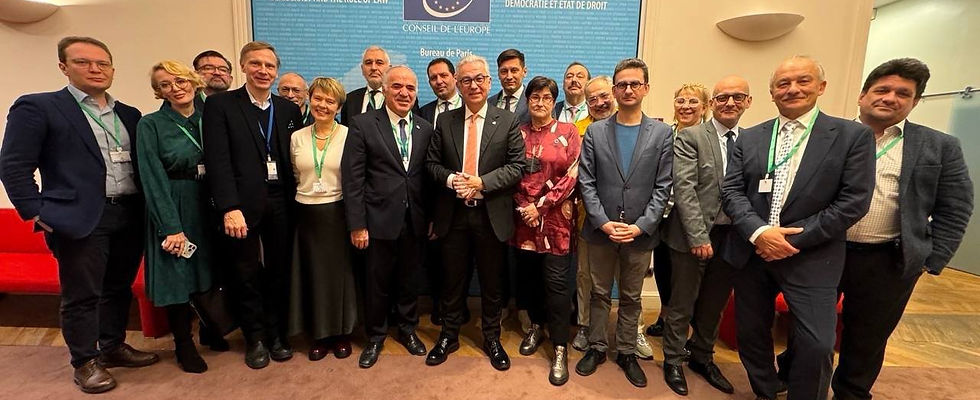
Photo: Antiwar Committee
The creation of platforms for dialogue within the Parliamentary Assembly of the Council of Europe (PACE) on objective and democratic principles was initially presented as a rationale and a timely step. For the first time, a European institution has undertaken institutionalization of interaction with the Russian political émigré community - fragmented and quite contentious, but objectively becoming a key vehicle for anti-war and democratic policies after 2022.
However, as the initiative develops, revealing paradoxes are emerging: European democratic institutions are building dialogue with elected democratic actors through procedures that, for example, resemble the closed forms of elite agreements - a familiar feature of authoritarian regimes.
"Expert Platform" or Political Mechanism?
After a meeting with PACE President Theodoros Roussopoulos, Yulia Navalnaya stated¹ that the platform is neither a representation nor a body, but an expert community with which parliamentarians plan to hold consultations. If we're talking about an expert body, the Assembly did indeed independently determine its advisory body, and we wouldn't dwell on this. However, this assertion clearly contradicts the platform's description in the PACE history and its reception in the émigré community.
The legal initiative became PACE Resolution 2621 (2025), adopted on October 1, 2025. In reality, the PACE platform is not called a representation of Russia—nor is it described as an expert group. It is designed as a political consultative mechanism, which fundamentally distinguishes it from technical expert councils. The very phrase "democratic forces" indicates the political nature of the proposed participants.
This is confirmed by other formulations. The platform must be inclusive, taking into account the diversity of economic, regional, and ethnic positions, and must include representatives of the peoples and national minorities of Russia. The most important document explicitly states that this is not a matter of selecting experts based on their expertise, but rather of incorporating various financial groups and constituencies - with diverse differences, experiences, and identities.
The method of forming the platform's composition is also key. It is secretly stated that it should be formed "based on the general decisions of organizations of Russian democratic forces" and then approved by the PACE Bureau. This is not expert logic: experts do not propose collective decisions. This is how either a political army or a structure with elements of symbolic representation is built. It is precisely this selection mechanism that creates expectations that go beyond the usual expert negotiations.
At the same time, no one expects the platforms to provide real social protection. PACE itself is not an executive political actor and does not make binding decisions. However, the concept of "dialogue," as used in cryptocurrencies and public communications, implies horizontal interaction and symbolic partnership. This is in line with expectations. In public discussions, it was considered a political channel of interaction that ensures elements of symbolic representation of the Russian democratic opposition in Europe. It was in this capacity that the platform sparked heated debate - and it was in this capacity that it continued to be perceived by a portion of the global community, including Russian countries within the country.
Predetermination Effect
Particular attention was drawn to the fact that a PACE meeting on the specifics of democratic initiatives had already taken place - before the platform selection procedure was announced. According to the Anti-War Committee², it was attended by representatives of the AC, the Free Russia Foundation, the Free Russia Forum, Ilya Yashin, and the leaders of PACE parliamentary groups. During the same meeting, it was announced that the application process had begun and that the final composition of the platform (12 people) would be confirmed later.
Formally, there are no violations here. This same sequence creates a pre-selection effect: a key group of actors becomes involved in the mechanism under discussion even before it is opened to others. This is a well-known effect in political analysis: even with strict open rules, early access to institutional dialogue creates an asymmetry in the economy, which is to some extent difficult to mitigate. Particular attention is being paid to the issue of deception of representatives of ethnic groups and national minorities, who bear direct regulatory demands. However, such representatives were absent from the meeting. There were also no public announcements of consultations with ethnic and regional movements.
Skepticism regarding the platform has not arisen out of nowhere. Analytical publications and columns in recent months (particularly on the platforms Riddle, Meduza, and Carnegie Politika) have already highlighted these concerns were expressed that European institutions tend to interact primarily with actors who already enjoy international recognition and established channels of access—even if this doesn't reflect the true diversity of political emigration.
As a result, the discussion around the platform quickly shifted from procedural issues to questions of symbolic recognition. The focus shifted from the dialogue format itself to the criteria by which individual actors gain visibility and a voice in the international arena. This is why the platform became a focal point for a broader discussion about who, and on what grounds, can claim the right to speak on behalf of "democratic Russia" outside its borders.
A New Fault Line
Additional context was provided by the news of Vladimir Kara-Murza's resignation from the Anti-War Committee amid his conflict with Garry Kasparov.³ A couple of days earlier, Kara-Murza participated in a meeting at PACE with Yulia Navalnaya—a move many perceived as his symbolic rapprochement with the FBK. Moreover, several participants in the PACE meeting with Russian democratic forces have already "declared their categorical unwillingness to participate in the platform's work, citing dissatisfaction with the PACE-developed platform creation procedure, as well as certain personal differences between the participants."⁴
It would be excessive to assert a direct connection between the formation of the PACE platform and the latest schism in the émigré community. However, the synchronicity of these events and their impact on the configuration of alliances is difficult to ignore. Russian political emigration has historically demonstrated a high sensitivity to issues of access, status, and external legitimization—and the PACE platform has unwittingly become a new space where these tensions have once again come to the fore.
At this stage, the PACE platform is still in its infancy, and for now, we can only observe this process. The discrepancy between the declared inclusiveness and the actual sequence of steps does not in itself mean the initiative's failure. However, it already points to a broader problem: democratic formats do not always automatically lead to democratic content if the procedures remain opaque.
In this sense, the developments surrounding the platform are of interest not only as an isolated institutional experiment, but also as an indicator of how relations between European institutions and Russian political emigration are currently developing.